
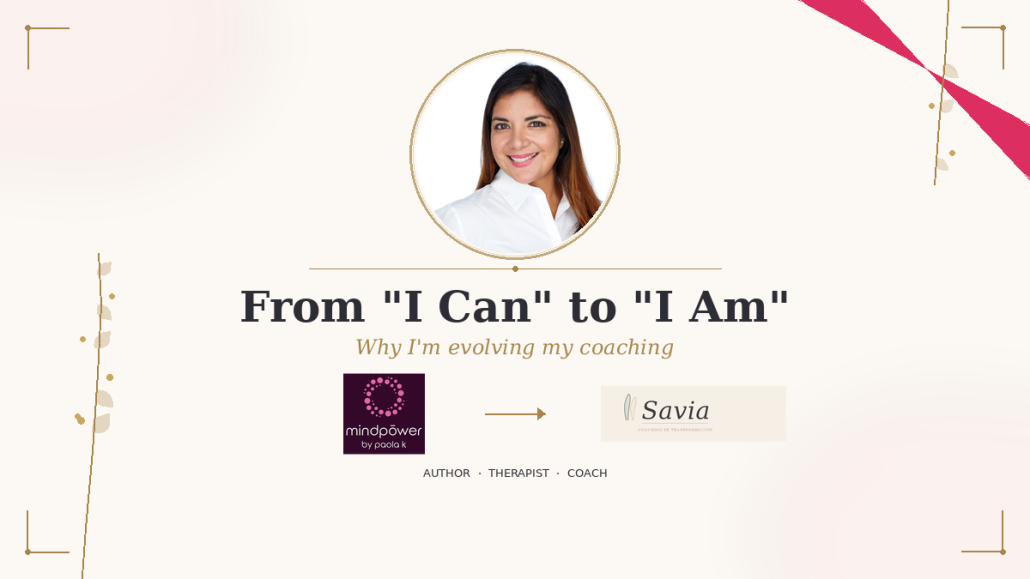
From “I Can” to “I Am”: Why I’m Evolving My Coaching
I came to the world of personal development with a very clear mindset: industrial engineer, MBA, global projects. Equipped with a simple equation: discipline + habits + positive mindset = change. I measured success in goals achieved, resilience demonstrated, vision fulfilled. I believed that change was a matter of willpower well directed. “You can do it,” I thought. “It all depends on you.”
And it works. Until it doesn’t.
I discovered the limits of that mindset when I came face to face with myself.
For years, My-Mindpower was the home of that coaching. I taught discipline, habits, stoic practices, positive mindset. We celebrated visions achieved and resilience demonstrated together. And it created value—it truly did. But after years of touching those topics only on the surface, I came across something that couldn’t be solved with productivity or “positive thinking”: there was something deeper. Something that no personal development book, no course on habits, could reach.
It was as if we were working on the surface, painting walls, rearranging furniture—but the structure of the house was still broken.
What changed everything for me was studying clinical psychology and psychotherapy. Not as an accessory to my practice, but as an admission that human nature is more complex than I had understood.
I discovered that behind every act of self-sabotage, there’s a story. That when someone says “I can’t move forward,” it’s often not a lack of discipline: it’s an invisible wound, a repeated relational pattern, a part of their own story they’ve been avoiding—consciously or unconsciously. An unquestioned loyalty to a belief absorbed in childhood. An “I don’t deserve this” hiding beneath layers of achievement.
Traditional coaching—the kind I learned, the kind I taught at My-Mindpower—doesn’t have the tools for that. It’s not designed to go to the core. And when you try without that depth, you touch surfaces. You generate movement, yes. But not true transformation.
Transformation requires something else: it requires going to the past. Rewriting a part of your story you’ve been postponing. Integrating what was rejected. Healing what was invisible.
That doesn’t happen in short sessions about “morning routines” or “goal management.” It happens in that deeper space where psychology and therapy converge—where the past speaks to the present, where what was fragmented can become whole again.
That’s why my practice is now called Savia. It’s not a meaningless rebrand; it’s the honest answer to what I learned. Because real change isn’t productivity. It’s coming back to yourself. It’s integrating all those parts of you that you’ve been avoiding or silencing. It’s only then—when you’re whole—that you can truly live at peace in the world.
My engineer’s mindset is still here. But now I know: the most important project isn’t reaching your goal. It’s healing what keeps you from seeing yourself.
