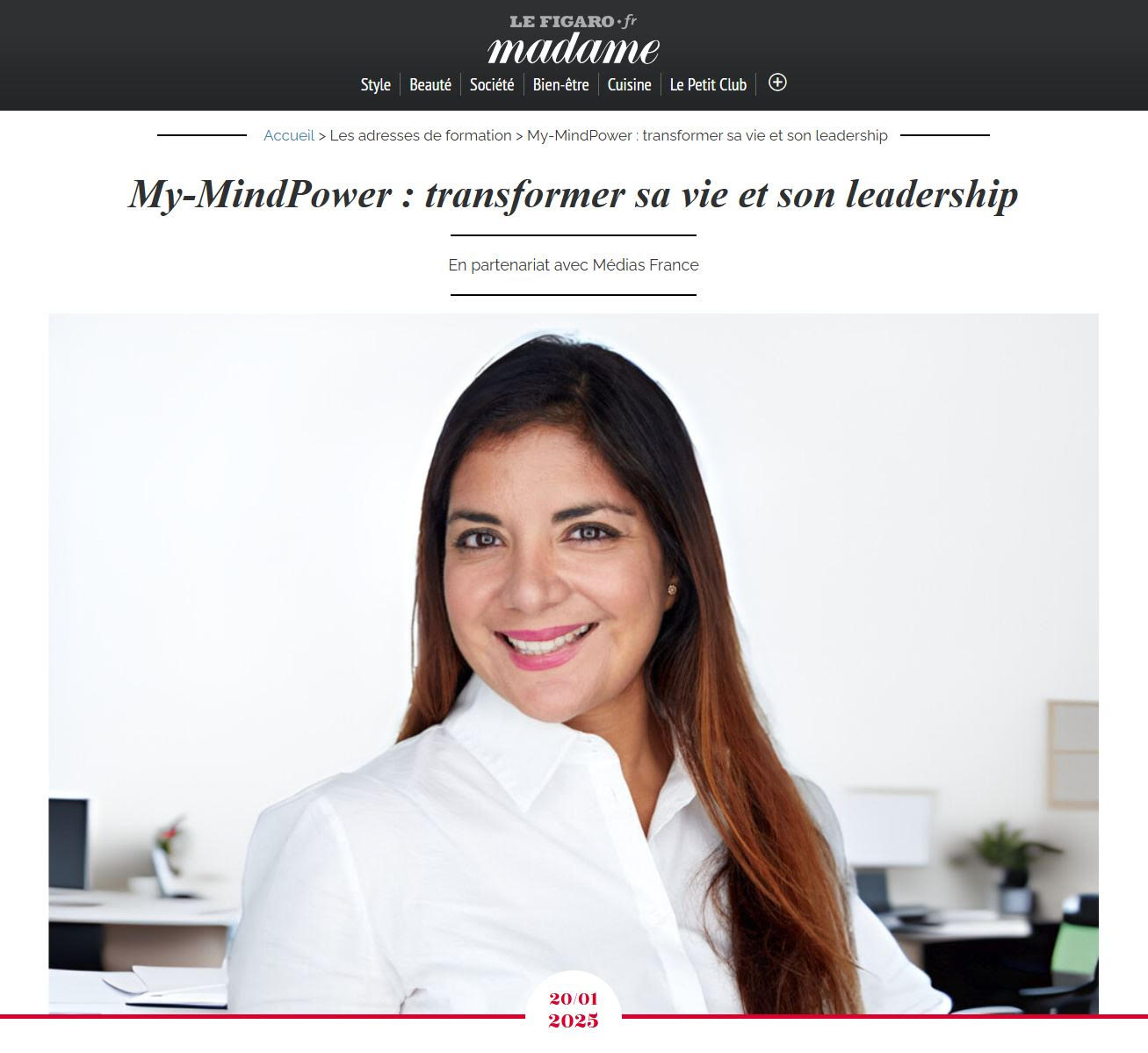
Interview with Madame Le Figaro: My-MindPower, Transforming Life and Leadership
Dear readers,

On this occasion, I had the opportunity to be interviewed by Madame Le Figaro magazine to share my ideas on coaching and leadership. Here I share the interview:

For Paola Knecht, mentor in personal and professional transformation, everything begins with a vision—a desire to transform life and realign with deep values through My-MindPower.

“Every Monday morning, I woke up with more stress than excitement about going to work. I asked myself: is this really what I want to do for the rest of my life?” she recalls.

In her book The Success Mindset, she proposes a six-step method. The first step consists of identifying what we truly love to do, without worrying about its viability or profitability. Next comes determining talents: what we do well or what those around us perceive about us. Paola encourages her clients to overcome mental blocks, especially the one that separates passion from work. “We are often taught that what we love cannot be a source of income. But why not consider combining what we are passionate about with something for which we can be paid? That is often where fulfillment lies,” she explains.

Finally, she invites her clients to reflect on the impact they want to have in the world and what legacy they want to leave behind. This approach helps define a clear and motivating direction.

Forging the Future of Leadership
Paola Knecht has always been fascinated by human psychology, particularly in the field of leadership. “Extraordinary leaders have something in common: a strong vision that guides their actions. That vision gives them purpose and makes them more effective and fulfilled,” she says. This concept, which she has explored in her books and mentoring sessions, is not limited to executives and managers.

As she points out, anyone can benefit from a clear vision to give meaning to their life—whether leading a company or simply creating a daily life aligned with their values. Paola also emphasizes that success has no universal definition. “For some, it may be running a small business that allows them to have time for their children or passions. For others, it is having a global impact. What matters is that it makes sense for the person themselves,” she notes.

Active Listening and the Role of Mentorship
What sets Paola Knecht and My-MindPower apart is the approach that combines coaching and mentoring. Unlike traditional coaching, which focuses on asking questions to guide clients toward their own answers, mentoring includes more specific and personalized advice. “Executives, for example, sometimes need a clear opinion on concrete problems,” she explains.

The key to the My-MindPower method? Active listening. “To guide someone, you must first deeply understand their needs, fears, and blockages,” Paola stresses. She helps her clients depersonalize their problems in order to analyze them objectively. “Often, leaders feel paralyzed by the fear of making the wrong decision. I help them take distance, map out the consequences of their choices, and move forward with clarity.”

Today, Paola Knecht supports clients around the world through online sessions and shares her knowledge through her books. After The Success Mindset, she recently published The Secrets of Discipline, where she explores the mental mechanisms that allow people to cultivate lasting discipline.

Inspiring and methodical, Paola Knecht demonstrates that finding one’s path and transforming life are achievable goals for everyone—provided we take the time to ask ourselves the right questions.

To access the article in its original language, you can visit the following webpage:

 

How to Overcome Procrastination and Take Control of Your Life


Procrastination is the silent thief of our potential. We set goals, make plans, and promise ourselves that we’ll start tomorrow—only to find ourselves trapped in the same cycle of delay and regret. But here’s the truth: procrastination isn’t just a bad habit. It’s a mindset problem, and the good news is that you can change it.

In The Secrets of Discipline, I wrote: “Success is not about waiting for motivation to strike. It’s about training yourself to take action, even when you don’t feel like it.” Waiting for the perfect moment is an illusion. The only way to break free from procrastination is to master the art of disciplined action. Here’s how:

1. Shift Your Mindset: Action Creates Motivation

Most people believe they need to feel inspired before they start working. The reality is the opposite: action creates motivation. Once you begin, even with a small step, your brain shifts gears and builds momentum. Try this: commit to just five minutes of work. Once you start, you’ll often find it easier to keep going.

2. Break It Down: The Two-Minute Rule

Big tasks feel overwhelming, which is why we delay them. Instead, break them into smaller, manageable steps. Use the “Two-Minute Rule”: if a task takes less than two minutes, do it immediately. If it takes longer, break it into a step so small that it takes only two minutes to start. This removes resistance and gets you into action mode.

3. Eliminate Distractions

Social media, notifications, and endless scrolling are modern-day procrastination traps. In The Success Mindset, I discuss the importance of controlling your environment: “Your focus is your superpower. Guard it fiercely.” Use techniques like the Pomodoro method—work intensely for 25 minutes, then take a 5-minute break—to stay focused and productive.

4. Reframe Your Fear of Failure

Many people procrastinate because they fear failing. But perfectionism is just procrastination in disguise. Shift your perspective: every action, no matter how imperfect, moves you forward. As Thomas Edison said, “I have not failed. I’ve just found 10,000 ways that won’t work.” Success is built on progress, not perfection.

5. Make Accountability Work for You

When no one is watching, it’s easy to delay. But accountability changes everything. Share your goals with a friend, join a mastermind group, or use an app to track your progress. In The Secrets of Discipline, I explain: “Commitment isn’t just personal. When others expect you to follow through, you’re far more likely to act.” Leverage social accountability to keep yourself on track.

6. Reward Progress, Not Just Results

If you only reward yourself when you achieve big milestones, you’ll feel discouraged. Instead, celebrate small wins. Every time you push past procrastination and take action, acknowledge it. Success is a series of small victories, not one grand moment.

The Challenge: Start NOW

Procrastination thrives on delay. So here’s your challenge: choose one task you’ve been avoiding. Set a timer for five minutes. Start it NOW. The first step is always the hardest, but once you take it, you’ll realize how much power you truly have.

***

PAOLA KNECHT is a certified leadership, transformational, and self-development coach, author of The Success Mindset: Take Back the Leadership of Your Mind and A World of Illusions: A Wake-Up Call and the Search for the Truth. Learn more at www.paolaknecht.com

The Power of Self-Discipline: Your Key to Success

Self-discipline is the foundation of success in every area of life. Whether you want to advance in your career, improve your health, or achieve personal goals, mastering self-discipline is essential. It is the ability to control impulses, stay focused, and follow through on commitments, even when motivation fades.

Why Is Self-Discipline So Important?

  1. Builds Consistency – Success is not about big, one-time efforts but about small, repeated actions. Self-discipline ensures you stay consistent, whether it’s in your work habits, fitness routine, or learning new skills.
  2. Increases Productivity – When you eliminate distractions and stick to a plan, you get more done in less time. Discipline helps you prioritize tasks and avoid procrastination, leading to better results.
  3. Enhances Self-Control – Learning to delay gratification and resist temptations allows you to make better decisions that align with your long-term goals. Instead of choosing immediate comfort, disciplined people focus on future rewards.
  4. Strengthens Resilience – Life is full of challenges, but self-discipline helps you push through obstacles and setbacks without giving up. It fosters mental toughness and determination.

How to Cultivate Self-Discipline

  • Set Clear Goals – Define what you want to achieve and break it down into small,manageable steps.
  • Create a Routine – Establish daily habits that reinforce discipline, such as setting specific work hours, exercising regularly, or practicing meditation.
  • Eliminate Distractions – Identify what derails your focus and take proactive steps to minimize them.
  • Practice Delayed Gratification – Train yourself to wait for rewards rather than seeking instant gratification.
  • Hold Yourself Accountable – Track your progress and seek support from mentors, friends, or coaches.

Self-discipline is not about perfection; it’s about progress. By consistently making disciplined choices, you create a life of achievement, growth, and fulfillment. Start today, and watch how self-discipline transforms your journey to success!

For more insights on mastering self-discipline, consult my book The Secrets of Discipline.

***

PAOLA KNECHT is a certified leadership, transformational, and self-development coach, author of The Success Mindset: Take Back the Leadership of Your Mind and A World of Illusions: A Wake-Up Call and the Search for the Truth. Learn more at www.paolaknecht.com


Discovering Your True Self by Confronting Your Fears

Personal transformation begins with a courageous act: facing our fears. When we confront these internal obstacles, we not only grow but begin to see the potential of who we truly are. The process requires vulnerability, courage, and a willingness to question deep-seated beliefs. As I explore in my book The Success Mindset and A World of Illusions, embracing our fears is a transformative journey that frees us to live authentically.

1. The Root of Transformation: Facing Your Fears

In The Success Mindset, I highlight the importance of confronting the fears that hold us back, stating: “The first step towards success is acknowledging what scares you and then choosing to stand up to it, not hide from it.” Our fears often stem from limiting beliefs—doubts about our worth, concerns about failing, or fear of judgment. By facing these emotions directly, we dismantle the walls keeping us from our potential.

When we engage with our fears rather than retreat, we gain insight into who we are. Transformation arises not from avoiding discomfort but by seeing our vulnerabilities as opportunities to grow and learn. Each fear confronted is a step toward discovering a truer version of ourselves.

2. Shedding Illusions to Find Authenticity

A critical part of transformation is letting go of illusions—the false narratives we have constructed about ourselves and the world. In A World of Illusions, I emphasize that only when we break through our illusions can we find clarity, freedom, and truth. These illusions may take the form of societal expectations, roles we believe we must fulfill, or misconceptions about what will make us happy. When we dissolve these illusions, we create space for our authentic self to emerge.

Letting go of illusions is a liberating yet challenging process. It involves questioning long-held beliefs, values, and even relationships that may not align with who we truly are. However, in releasing these, we gain the clarity needed to recognize our genuine passions and strengths.

3. Embracing Vulnerability as a Strength

True transformation occurs when we allow ourselves to be vulnerable. Vulnerability, often seen as weakness, is in fact the essence of strength. Confronting fears and shedding illusions is a deeply vulnerable process that requires acceptance of our imperfections. I capture this sentiment in The Success Mindset. Strength is not about hiding your weaknesses, but about accepting them and daring to move forward despite them.

Being vulnerable means permitting ourselves to take risks, to explore parts of ourselves we may have repressed, and to embrace change. This openness to transformation encourages growth and a genuine connection to ourselves and others.

4. Living Authentically: The Ultimate Goal

The result of confronting fears, shedding illusions, and embracing vulnerability is a more authentic life. When we break free from fears and illusions, we find a unique purpose that resonates deeply within. The world changes when we choose to live as we are, unburdened by fear, bound only by the truth we carry within.

Personal transformation through facing fears and embracing authenticity is a lifelong journey. It requires courage, honesty, and a deep commitment to self-discovery. By stepping into this process, we do not merely exist but truly live—free from the shadows of fear and illusions, fully empowered to be who we are meant to be.

PAOLA KNECHT is a certified leadership, transformational, and self-development coach, author of The Success Mindset: Take Back the Leadership of Your Mind and A World of Illusions: A Wake-Up Call and the Search for the Truth. Learn more at www.paolaknecht.com


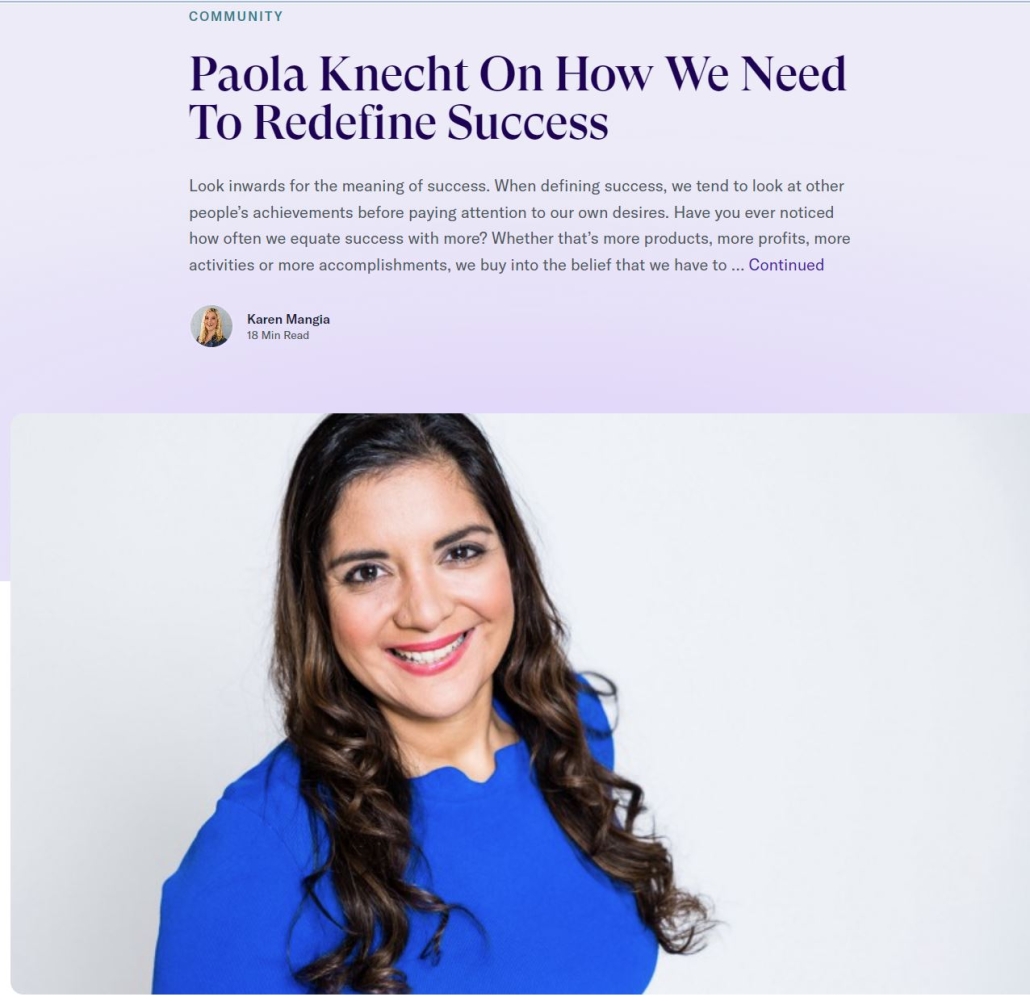
Paola Knecht on How We Need to Redefine Success

Interview conducted by Karen Mangia for Thrive Global

In an interview for The Thrive Global by Karen Mangia, Paola Knecht discusses the need to redefine success, a central theme of her book The Success Mindset.

Knecht emphasizes the importance of looking inward to discover personal definitions of success, as opposed to relying on societal norms that equate success with wealth, status, or the accumulation of “more”—whether it’s more products, achievements, or recognition.

Knecht shares her personal journey, moving from a promising career in international management to becoming a self-development coach and author. Despite having material success, she realized she wasn’t aligned with her true passions of writing and helping others. This turning point helped her define success as living authentically and pursuing what truly matters, rather than conforming to external expectations.


In the interview, Knecht outlines five key lessons for redefining success:

  1. Look inward: Define success based on personal desires, rather than imitating others’ achievements.
  2. Live as a role model: Make a positive impact on the world by fighting for causes or dreams that matter to you.
  3. Value simplicity: Embrace the joy found in simple pleasures and focus on what truly brings fulfillment.
  4. Stay curious: Cultivate curiosity to stay inspired and open to new perspectives, which can fuel personal growth.
  5. Reject one-size-fits-all success formulas: Avoid ready-made recipes for success and instead craft your own unique path.

Knecht also highlights the obstacles to achieving this redefined success, particularly the need to overcome limiting beliefs and bad habits. She advises making a conscious effort to live intentionally, cultivate self-awareness, and stay true to one’s core values.

Ultimately, Knecht encourages readers to reclaim their narratives and define success on their own terms, as this inward reflection is an essential act of self-love, personal empowerment, and long-term fulfillment.

For more insights, you can visit the full interview on The Thrive Global website here.

Interview with Dr. Sarah E. Brown on the KTS Success Factor Podcast about the Definition of Success

Success doesn’t have a specific shape, size, or form.

We all have our own definition of success, but oftentimes, we get swayed by what we see on social media. It can unconsciously influence us.

So how can you avoid this hazard, and really commit to the life you’ve always envisioned for yourself?

In this interview, I share with Sarah my own definition of what success is and how we can shift our definition of success toward something that truly excites us and is authentic to ourselves. She will also guide us through some of the key pillars mentioned in her book to help us discover our vision and make more conscious decisions about our lives.

What you will learn from this episode:

  • Discover how you can define your own success story instead of letting others do it for you.
  • Learn powerful questions you can reflect on to help you understand what you really want.
  • Understand the importance of having a vision in defining your own success.


Key Takeaways:

“Success, when I come back to the essence of it, it’s really to discover the meaning of your life, to discover your vision, something that goes beyond the race of accumulating things, or following a path that you did not consciously choose for yourself.” – Paola Knecht

“You have to look inward, instead of outward. We are distracted.” – Paola Knecht

“I believe, over time– all these have a root cause. And I believe one of those is that we spend way too much time comparing ourselves to other lives and not paying enough attention to ourselves first.” – Paola Knecht

“It all starts with really going back to the basics and asking yourself, “What do I really love about my life, about me?” – Paola Knecht

“If I have an awareness about the things I love doing, and they are meaningful for me, then how can I connect that passion with some activity that I enjoy? Or how can I connect that to bring service to others?” – Paola Knecht

“We all have talents and gifts that come inherited, and they are wonderful. And it’s also great when we discover them and they can really bring us great surprises.” – Paola Knecht

“It’s really about not underrating the value of hard work because that’s what really brings you far.” – Paola Knecht

“To take the conscious decision to basically log out, to take some time offline, and really take more time to discover who you really are, and what you’re after.” – Paola Knecht

“If we really want to know ourselves better, we also have to invest time to know ourselves better.” – Paola Knecht

“You have the power to take back your own life. And for this is really to make the conscious decision to go on that journey of self-discovery. You can and have the power to define your success story. And do not let other people tell you what these should look like. You can write your own story and find transcendence in doing it.” – Paola Knecht


The Power of Intentions: Shaping Our Reality

Reality is a marvelous thing. It’s not just something that happens to us, but something we actively participate in creating. Our thoughts, beliefs, and intentions play a significant role in shaping the world we experience. In other words, what we intend, we manifest.

From the ancient wisdom of spiritual traditions to modern scientific discoveries, there’s a growing recognition of the power of intention in shaping our reality. Let’s delve into how our intentions have this remarkable ability to influence our lives.

Understanding Intentions

Intentions are the thoughts, desires, or aims that guide our actions. They are the driving force behind everything we do, whether we’re conscious of them or not. Intentions are like seeds planted in the soil of consciousness; they have the potential to grow and bear fruit in our lives.

The Law of Attraction

The Law of Attraction, popularized by the book and movie “The Secret,” suggests that like attracts like. In other words, whatever we focus on, whether positive or negative, we attract into our lives. This concept is deeply rooted in the power of intention.

When we set positive intentions, we align our thoughts and emotions with the things we want to manifest. By focusing on abundance, joy, love, and success, we invite these experiences into our reality. Conversely, dwelling on negativity, fear, or lack only serves to attract more of the same.

The Power of Belief

Our beliefs shape our perceptions and, consequently, our reality. Henry Ford famously said, “Whether you think you can or you think you can’t, you’re right.” Our beliefs act as filters through which we interpret the world around us. If we believe we are capable, worthy, and deserving of success, we are more likely to take actions that lead to success.

Intention and Action

Intentions are not merely wishful thinking; they require action. Taking consistent, purposeful action towards our intentions strengthens their manifestation. When we align our actions with our intentions, we signal to the universe our commitment to bringing them into reality.

The Power of Visualization

Visualization is a powerful tool for manifesting intentions. By vividly imagining ourselves already experiencing our desired outcomes, we create a mental blueprint that guides our actions. Visualization enhances our focus, motivation, and belief in the possibility of our intentions coming true.

The Ripple Effect

Our intentions not only influence our own reality but also have a ripple effect on the world around us. When we radiate positivity, kindness, and compassion, we inspire others to do the same. Our intentions can create a domino effect, spreading positive change far beyond our immediate sphere of influence.

Cultivating Positive Intentions

  1. Clarity: Be clear about what you want to manifest in your life. Define your intentions with as much detail as possible.
  2. Positivity: Frame your intentions in a positive light. Instead of focusing on what you don’t want, focus on what you do want.
  3. Belief: Cultivate unwavering belief in the possibility of your intentions coming true. Trust in the process and believe in yourself.
  4. Gratitude: Practice gratitude for what you already have. Gratitude opens the door to receiving more abundance.
  5. Action: Take inspired action towards your intentions. Break down your goals into actionable steps and consistently work towards them.
  6. Visualization: Spend time each day visualizing yourself living your intentions. Engage all your senses and immerse yourself in the experience.

Our intentions are potent forces that shape the reality we experience. By harnessing the power of intention, we can create lives filled with abundance, joy, and fulfillment. Whether through the Law of Attraction, the power of belief, or the ripple effect of positivity, our intentions have the ability to transform our lives and the world around us. So, dare to dream big, set your intentions, and watch as your reality begins to align with your deepest desires!

***

PAOLA KNECHT is a certified leadership, transformational, and self-development coach, author of The Success Mindset: Take Back the Leadership of Your Mind and A World of Illusions: A Wake-Up Call and the Search for the Truth. Learn more at my-mindpower.com.

Unlocking Your Vision: A Guide to Success

In the journey towards success, having a clear vision is like having a roadmap—it guides your actions, fuels your motivation, and keeps you focused on your goals. In her insightful book, “The Success Mindset,” Paola Knecht explores the power of vision and how it can transform your life. Let’s delve into the key principles of finding your vision and realizing your dreams.

Understanding Vision

What exactly is vision? It’s more than just a goal or aspiration; it’s a vivid mental image of your ideal future. Your vision is the ultimate destination you want to reach, the big picture that inspires and drives you forward. As Knecht emphasizes, cultivating a strong vision is essential for achieving success in any endeavor.

Clarifying Your Purpose

To find your vision, you must first clarify your purpose. What is it that truly lights a fire within you? What do you feel passionate about? Reflect on your values, interests, and talents. What impact do you want to make in the world? Your vision should align with your deepest desires and values, giving your life a sense of purpose and direction.

Visualizing Your Future

Once you’ve identified your purpose, it’s time to visualize your future. Close your eyes and imagine yourself living your ideal life. What does it look like? What are you doing? Who are you with? Visualize every detail with clarity and intensity. As Knecht suggests, immerse yourself in this vision until it becomes as real to you as your present reality.

Setting Bold Goals

With your vision in mind, it’s time to set bold goals that will propel you towards your desired future. Break down your vision into smaller, actionable steps and set specific, measurable goals to achieve them. These goals should stretch your abilities and push you out of your comfort zone. As Knecht writes, “Goals should be big enough to excite you, yet realistic enough to believe you can achieve them.”

Overcoming Obstacles

On the path to realizing your vision, you’ll inevitably encounter obstacles and challenges. The key is to view these challenges as opportunities for growth rather than setbacks. Stay resilient and adaptable, and be willing to adjust your course as needed. As Knecht advises, “Success is not the absence of failure, but the ability to persist in the face of it.”

Staying Committed

Finally, staying committed to your vision is essential for long-term success. Cultivate a success mindset that fuels your determination and resilience. Surround yourself with supportive people who share your vision and encourage your growth. As Knecht writes, “Your vision is your compass; let it guide you through the ups and downs of your journey.”

In “The Success Mindset,” Paola Knecht highlights the importance of finding your vision as a key step towards achieving success. By clarifying your purpose, visualizing your future, setting bold goals, overcoming obstacles, and staying committed, you can unlock your full potential and create the life you desire. As Knecht reminds us, “Your vision is the starting point of your journey to success. Embrace it, nurture it, and watch it unfold.”


*  *  *

PAOLA KNECHT is a certified leadership, transformational, and self-development coach and author of The Success Mindset: Take Back the Leadership of Your Mind. Learn more at my-mindpower.com.

My Dream Begins

Since that obscure Winter,

I never saw the sunshine again,

my soul was filled with disillusionment,

I blinded the two lights so I couldn´t see through them;

those darkest thoughts still live in my deepest soul.

My only wish was to disappear,

to go far, to abandon the real world.

The time passed by

and today, I felt my awakening;

the eyes of my soul could now see,

those thunders of light that the sun projects every day.

Free, free like the rain, like the air.

I feel now purified, I have returned to the real world.

Those painful moments have already gone away.

There’s nothing to fear,

there’s nothing that can fill my eyes with tears again.

Now my eyes have already stopped bleeding.

Today, I conclude this stage of my life

And my dream begins.

June 5, 2002 by Paola Vazquez (Knecht)

The Meaning of Personal Transformation

I have been reflecting these past days about the word transformation.

We know that life’s engine is through transformation. Everything alive evolves to fulfil a specific purpose. A small seed can transform itself into a wondrous Oak tree, just as a small caterpillar transforms itself into a  beautiful butterfly.

But what does that mean for us? How can we be aware of our own transformation?

Just the other day I heard a remarkable speech by Robert F. Kennedy Jr., which precisely talks about transformation. He shared his own experience with this phenomenon. What he said really stuck with me and made me think further about the topic. 

He shared his own experience with transformation. During his youth, he used to be a drug addict and he even described himself as a “bundle of desires”. His life was completely driven by a total self-will. After a certain time, a life driven by self-will ends up becoming meaningless. He struggled to find meaning anymore to what he was actually accomplishing. The world seemed chaotic, dull and unbearable. Until one day, he decided to surrender, and turn his will to a Higher Power. Once he surrendered to serve a higher purpose, is when he understood the meaning of transformation.

Every decision in his daily life, whether small or big, had now a moral dimension, and he realised that by making the right choices his life started to change and rewards and blessings came very fast. He keeps on saying that when his life became fully rewarded he still tries to keep his humility in place because that’s the only way that you can keep connected to the Higher Source. It is particularly challenging when things are going well in your life, he says, because when things go well one hardly thinks about God or in asking for help. 

Most people who are desperate and helpless tend to turn to God for help. But what happens when you are doing great? How do you keep finding meaning in your life despite your many blessings?

This explains maybe why so many people experience anxiety and depression, even though theoretically they have everything: a house, food on the table, and even family and friends who love them. Why do so many people fall into addictions and cravings of all types? Wouldn´t it be because they are lacking a life with real meaning?

When I examine my own life, I realize that what keeps me going is my desire to help. I have a deep desire to be of service and to share everything I know that can help people navigate through this dense, toxic World. I know that I have the moral responsibility to act in the service of what is right and what I regard as the truth. I wake up every day thinking I have to report to God for another day at His service. 

To take decisions with a moral dimension is what psychologist Jordan Peterson would say is making your bed every day, tidying up your room and showing up at work even if you don’t feel like it- because it is not about you, but it is all about what you are offering to the World. Is to work towards becoming a much better person than what you are today. It is to explore the potential of being. It is in the limits of the unknown where we have the field play of becoming. 

Eventually, how others see you means nothing. What is meaningful is how you see yourself. A superior man thinks about virtue; a petty man thinks about comfort.

How do you feel about the word transformation?

How would you transform yourself into someone who can live purposefully and plenty?

 I would love to hear your experience.

To learn more about the topic, I invite you to read my book:

The Success Mindset: Take back the leadership of your mind

God bless,

Paola K.